
The First Principle of Capitalism


Subtitle: Why We Must Innovate
In my last post, I wrote that innovation is a grueling process of repeated failure—a daily defeat. (Read the previous post)
This naturally leaves us with one fundamental question:
What drives people into the punishing depths of failure? What is the true motive that compels them to tirelessly attempt the painful process of creating something out of nothing?
Some say, "To enrich humanity by building something the world has never seen." They're not wrong. There are certainly innovators, artists, and creators who are driven purely by a mission to change lives.
But can that beautiful sense of mission alone sustain you in this ruthless capitalist world? On a battlefield where your bank balance dries up every month and the bills pile up, a vague sense of mission wears thin very quickly.
Yet, saying it's "just to make a lot of money" doesn't quite fit either, because 'innovation' is the riskiest, most inefficient choice you can make.
If money is the goal, there is no reason to invent something new. Statistically, it is much safer and faster to follow a path others have already paved, undercut a proven business model, or open a franchise. Innovation—forging a path that never existed—is a gamble with terrible odds, where the probability of failure overwhelmingly exceeds the chance of success.
If a noble sense of mission isn't enough to endure it, and it's too reckless to be explained by mere greed, what on earth drives people to innovate?
The First Principle of Capitalism
Before answering that, let's ask a fundamental question: How are prices determined in a capitalist market? By adding a reasonable margin to the cost of production?
Wrong.
The answer is surprisingly simple.
"Because someone is willing to pay for it." I call this The First Principle of Capitalism.
Why does a modern art piece—a few streaks of red paint on a canvas—sell for tens of millions of dollars? Is it because the canvas and paint are expensive? No. It’s simply because someone is willing to pay that money to buy it.
Why does a luxury bag made of a few pieces of leather sell for tens of thousands of dollars, or a single red brick with a brand logo get resold for hundreds? There is only one reason: someone is willing to open their wallet at that price point. The 17th-century tulip mania and the recent frenzy of NFT speculation can easily be understood through this lens.
This is the golden rule of how prices are set in capitalism. Prices aren't dictated by the producer’s costs; they are established the moment a consumer agrees to pay.
So, when do people accept these seemingly absurd price tags without complaining? When do they gladly hand over their money without questioning the cost?
The answer is clear: when there is 'no point of comparison.'
What Does Innovation Create?
Think back to 1902, when Willis Carrier developed the first modern air conditioning system in human history.
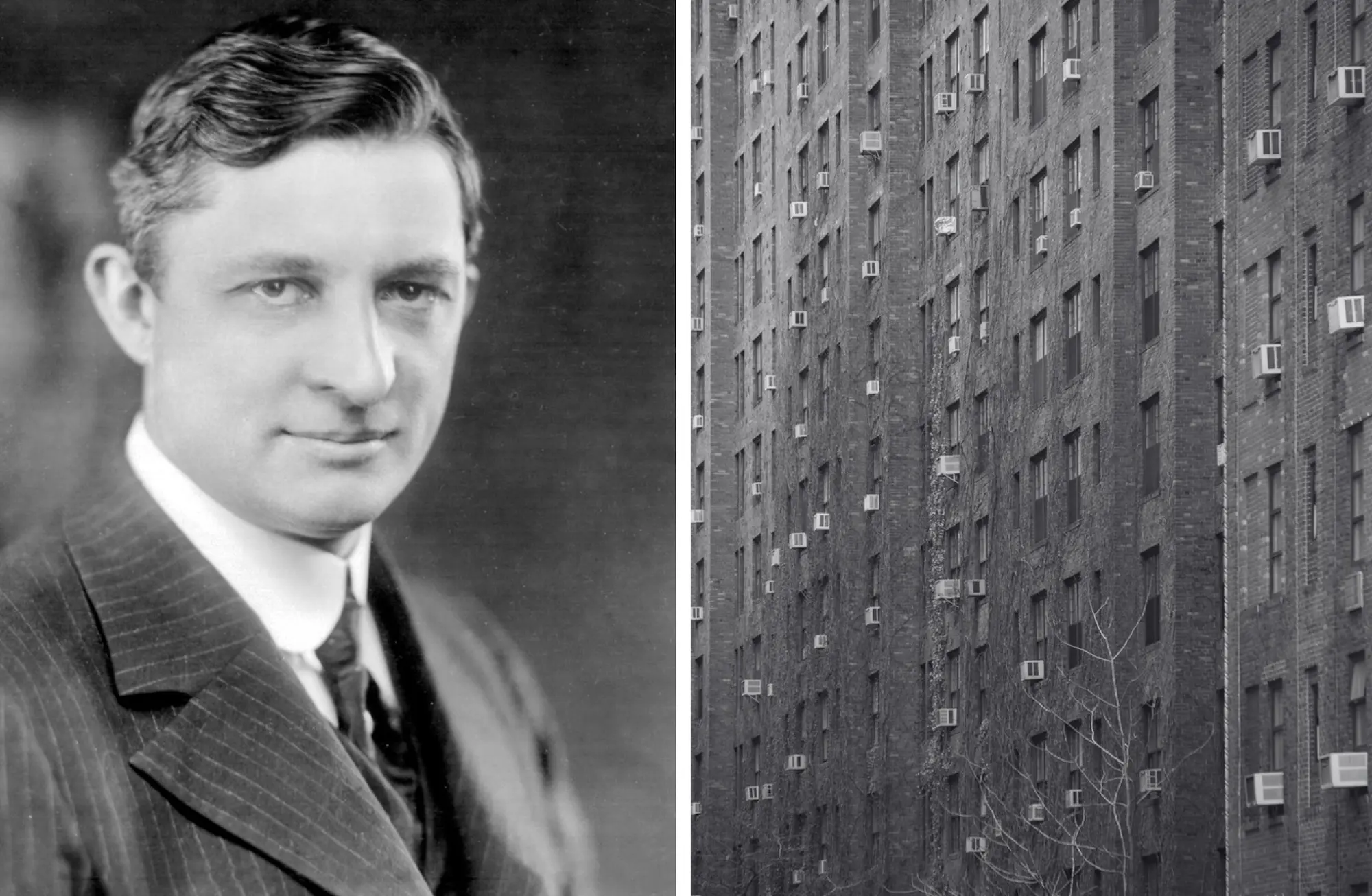
At the time, a large printing plant in Brooklyn, New York, went through hell every summer. The heat and humidity warped the paper and smeared the ink, making printing impossible. The losses incurred while shutting down the factory were astronomical.
That's when a 26-year-old engineer named Carrier stepped in and installed a massive cooling machine that controlled the humidity and chilled the air inside the factory. What was the "fair price" for this machine at the time?
$500? $5,000?
The correct answer is whatever price the buyer willingly agreed to.
While the exact contract for the first air conditioner doesn't survive, the price of early commercialized AC systems was worth hundreds of thousands of dollars in today's value ($10,000 to $50,000 at the time)—the price of a decent house.
Despite this, factory and theater owners didn't try to haggle. They eagerly opened their wallets. That machine was a miracle with absolutely no point of comparison. Regardless of the machine's cost, the value it provided—keeping factories running all summer and packing empty theaters with people—was worth dozens of times its price. Carrier didn't have to undercut competitors, and the printing plant owner didn't hesitate before that hefty price tag. Ultimately, because someone was willing to pay for it, that unprecedented number became the true 'market price.'
Where Innovation Fades
But what about the air conditioner market today, 100 years later? The moment comparisons emerge, the game changes entirely.*
Cooling technology has been completely standardized, and dozens of manufacturers use the exact same components and refrigerants. Consumers pull up price-comparison sites, line up square footage, energy efficiency ratings, and power consumption side-by-side, and click on the model that is even a few dollars cheaper.
In the space where innovation has faded, companies resort to making AC filters slightly denser than the competition, or cutting costs to shave off a few dollars. Trapped in the comparison game, they desperately churn out minor tweaks until there is nothing left to call an innovation. They cry "Product Innovation!" hoping to be recognized for higher value, but consumers' standards are already too high, and the actual added value shrinks to almost nothing.
Even the great invention that liberated humanity from the sweltering heat is now trapped in a spec war, where it only sells if it undercuts the competition by a penny.
The moment alternatives exist, the supplier loses the power to dictate the price forever.
The reason an Americano at a local cafe costs $4 isn't because the coffee beans and paper cup cost 80 cents. It's because the cafe next door charges $4. The moment you slap an $8 price tag on it without any explanation, the customer will turn around and walk next door without a second thought.
If the shop next door lowers its price, I have to lower mine. If they hand out coupons, I have to burn marketing dollars. The lifeline of my business is held hostage by the price tag someone else set. This is the essence of the exhausting price war that countless self-employed business owners and small merchants fall into. It is dictated by the so-called "laws of supply and demand" (the invisible hand; the market) that we are all so tired of hearing about.
Why We Must Innovate
Let's return to the question we started with.
Why do countless innovators and entrepreneurs willingly wade through the hell of failure just to create new value? Are they simply gluttons for punishment?
Of course not.
It’s because they reject the very trap of comparison—the life of fighting tooth and nail to defend a few pennies of margin inside a pit someone else already dug.
A market saturated with comparisons is inevitably a zero-sum game. In a world where you starve to death if you don't steal the customer from next door, competition is nothing more than an exhausting war of attrition that eats away at everyone. In that arena, no matter how hard you struggle, not a single ounce of new value is created.
In that sense, true innovation ends the fight for survival that relies on stealing food off someone else's plate. By creating irreplaceable value that never existed before, it tears open new territory.
When Carrier invented the air conditioner, he wasn't stealing food from another mechanic's mouth. He erased the world's limitation that factories couldn't operate in midsummer, expanding the entire industry's horizon to a completely new dimension.
Innovation is the only act that turns a zero-sum game (stealing someone else's pie) into a positive-sum game (creating a new pie).
Refusing to participate in a closed system where everyone slowly starves while tearing at each other. Creating a new pie instead of coveting someone else’s. That is the fundamental reason people march into the perilous battlefield of innovation, even while bearing the brutal cost of failure.
➔ Coming Next: Is an Economic Crisis Coming Soon?
Peter Thiel even went so far as to forcefully state, "Competition is for losers."* He points out that the very fact you are competing means you are constantly being compared and valued against someone else, and in that game, you can never truly be the winner.