
5 Essential SK Management Principles Every Manager Must Know (to Revive Your Team)
As a company grows, sophisticated reporting systems and numerous metrics emerge. But it’s strange: the more perfect the system becomes, the…

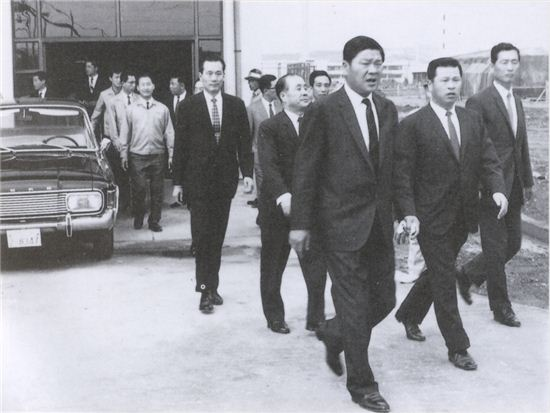
As a company grows, sophisticated reporting systems and numerous metrics emerge. But it’s strange: the more perfect the system becomes, the more the wild spirit of the members vanishes, and the organization grows heavy, like a sinking ship. 40 years ago, facing a giant-sized SK, Chey Jong-hyun designed a path no one had ever taken to solve this puzzle of ‘organizational aging’.
📍 1. Chaos: The Raid of a Giant Organization Beyond Order
In the late 1970s, SK grew relentlessly.
But Chey Jong-hyun was not at peace.
As the company expanded, reports got thicker, but the vivid energy of the field was drying up.
He sensed it instinctively:
“We cannot run this massive engine with the current rule-of-thumb management. Yet, we cannot win hearts with military-style orders alone.”
This was the essential business bottleneck (The Bottleneck) he faced.
Capital and technology can be brought in, but aligning the ‘motive’ of tens of thousands of people in one direction was a problem of a completely different dimension. The suffocating paradox where trying to establish order killed the spirit, and trying to revive the spirit brought chaos.
📍 2. Establishment: The Constitution of Management, The Birth of SKMS
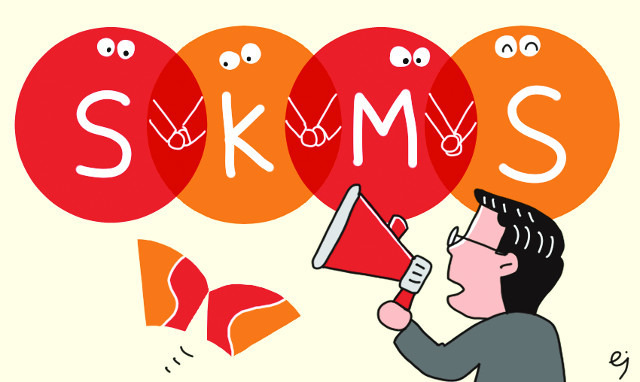
He began to dissect management academically.
In 1979, he released a document unprecedented in Korean management history:
the SKMS (SK Management System).
His perspective was unique.
He divided management elements into ‘Static elements (Finance, HR, Planning)’ and ‘Dynamic elements (Motive, Capacity, Grit)’.
While others clung to numbers and reports — the ‘Static elements’ — Chey focused on systematizing the explosive power of the invisible ’Dynamic elements’.
“Management is not the skill of using people, but the creation of an environment where people want to work.”
This was the new management solution (The Solution) and insight he shared with the world.
📍 3. Extremity: Challenging Theoretical Possibilities with SUPEX
He did not stop there.
In 1989, he presented a further set of behavioral guidelines:
the SUPEX (Super Excellent).
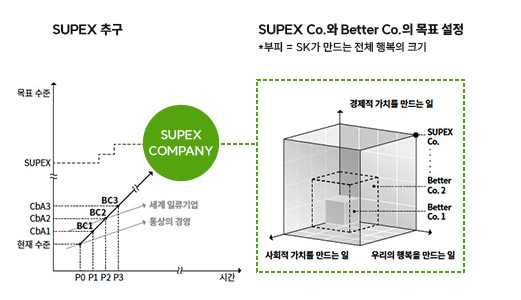
It meant setting a goal at the ‘highest level’ reachable by human ability.
Not just being better than competitors, but aiming for the Theoretical Absolute High (Super Excellent). Since reaching it at once is difficult, he set a ’Better Company’ as a milestone — repeatedly achieving one step higher until reaching the SUPEX Company.
To achieve this, he established a specific ’5-step Methodology’:
1. Multidimensional Location Analysis: Analyzing current position and environment.
2. KFS (Key Factor for Success) Search: Deriving core success factors.
3. Goal Setting: Establishing challenging goals.
4. Bottleneck Removal: Identifying and solving obstacles.
5. Action Plan: Developing and executing specific plans.
He told his employees:
“It is cowardly to set a low goal and achieve it. Management is about setting the highest goal and learning from the process.”
📍 4. Harmony: Coexistence of System and Respect for Humans
Many people think of a ‘system’ as a prison that stifles humans.
But Chey’s system was exactly the opposite.
He placed the belief that “Humans are autonomous and creative beings” at the very bottom of the system.
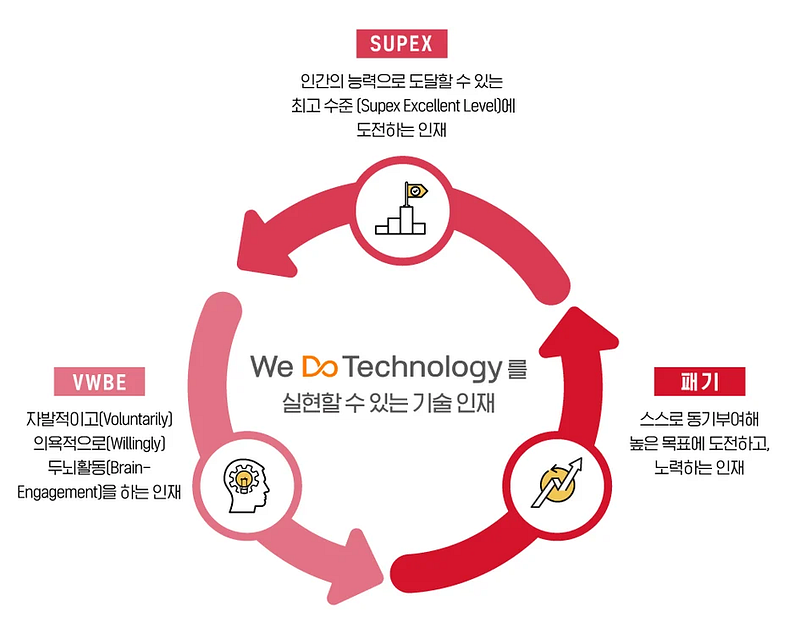
This was the VWBE (Voluntarily, Willingly, Brain Engagement) culture, where members exercise their full potential for their own happiness.
Voluntarily: The power to move by oneself, not by command.
Willingly: Strong will and passion.
Brain Engagement: Intellectual activity totalizing knowledge and capacity.
The practical attitude where VWBE is manifested externally is Grit — challenging high goals and producing results through creative shifts in thinking. SKMS was not a means of control, but a ’shared map’ enabling everyone to communicate in the same language and dream bigger dreams.
📍 5. Projection: What is your ‘Management Constitution’?

Today, we live in an era of AI and tools.
But the reason why introducing numerous tools doesn’t lead to performance is that we are missing the ‘Dynamics of people’ that move those tools.
Look again through Chey’s insight.
Is there a minimum set of principles and a maximum vision that team members can take pride in, saying “This is our way”?
Systems should exist not for management, but for liberating human potential.
Epilogue: Management is not control, but liberation.
Chairman Chey Jong-hyun brought management back from the realm of ‘numbers’ to the realm of ‘people’.
He proved the Happiness Cycle: where member happiness leads to VWBE, which leads to SUPEX pursuit, ultimately growing the happiness of both the company and the members. He showed that a system does not alienate humans but, rather, is a tool that allows them to be engaged most humanly.
What is the ‘dead order’ that must be erased first in your organization?
And what is the principle of ‘living energy’ that will fill its place?
Micro-Mission “Checking ‘Static vs Dynamic’ in Our Team”
Today, divide your work list into ‘Static elements (Result reports, data organizing)’ and ‘Dynamic elements (Conversations with team members, motivating, gritty proposals)’.
If static elements account for more than 90%, it’s a signal that the system is swallowing the people.
Today, ask exactly one team member or colleague a real question that awakens their ‘motive’.
“Management is people. Maximizing human ability is the essence of management.” — Chey Jong-hyun